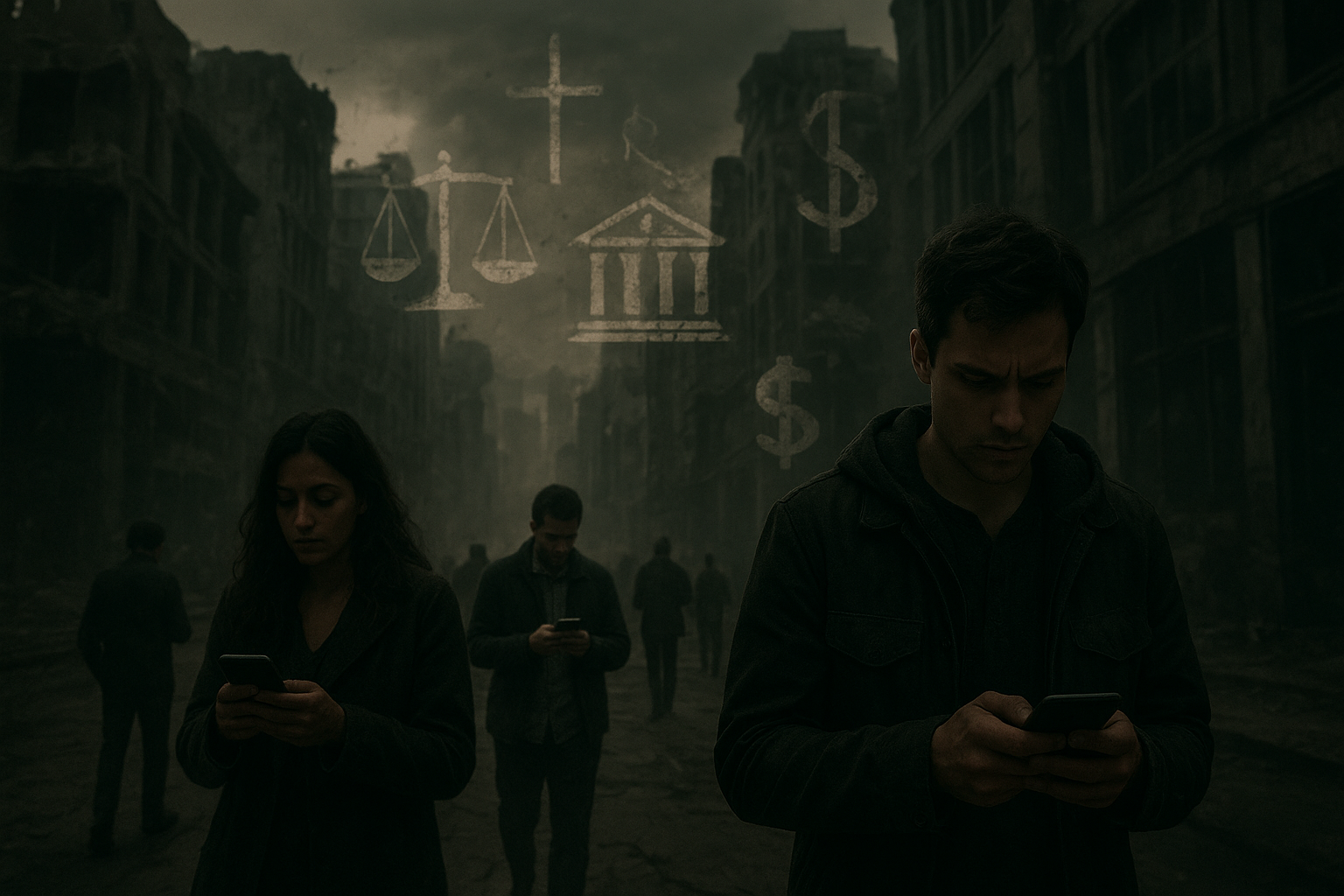
Nihilism was never meant to be pretty. At its core, it is the belief that nothing values, morality, purpose, truth holds any inherent meaning. Historically, nihilism haunted philosophers, revolutionaries, and artists who saw the collapse of old institutions and wondered what would rise in their place. Today, nihilism isn’t just a philosophy. It has become a cultural mood, a digital inheritance, and a quiet, growing force shaping how people think, feel, and respond to the world around them.

The internet didn’t invent nihilism. It industrialized it. What once lived in philosophical texts now circulates through memes, dark humor, short-form content, and the emotional exhaustion of a society overstimulated, under-grounded, and unsure of what’s real anymore. Not the playful, ironic “optimistic nihilism” trending across platforms. Not the mood-board aesthetic people romanticize online. This is the deeper current corrosive, subtle, and spreading.
The Culture of Collapse
Modern nihilism doesn’t walk through the front door. It slips in quietly, through emotional fatigue and information overload. Every day, people scroll through a blur of tragedy, comedy, scandal, crisis, and distraction without time to process anything. When everything feels temporary, everything begins to feel meaningless.
The detachment becomes a shield. In a world that feels unstable, believing in something feels risky. Caring feels exhausting.

The mind protects itself by going numb, and that numbness eventually becomes a worldview. Meaning doesn’t vanish suddenly. It erodes slowly, almost invisibly, until people can’t remember the last time anything felt real.
It shows up everywhere in humor, dating culture, political conversations, social trends built on hopelessness. Trust collapses, first in institutions, then in relationships, then in the self. And by the time people notice, the erosion is already deep.
The Modern Machinery of Meaninglessness
What used to be a philosophical question is now the emotional setting of the digital age. Not because people want to believe in nothing, but because the systems around them are built on overstimulation, contradiction, and speed.

The constant stream of content reshapes the mind. Outrage followed by comedy, grief followed by celebrity gossip, a crisis sandwiched between distractions. The contradictions break something internally. And instead of strengthening, the mind adapts by dulling its response.
Numbness becomes identity. Caring becomes a liability. Meaning becomes a luxury.
This is how nihilism spreads quietly, culturally, without ever announcing itself.
A Society Numb to Itself
Nihilism thrives when the social fabric weakens. Institutions contradict themselves in public. Truth becomes contested. Misinformation travels faster than facts. People lose faith not because they want to, but because they no longer know what or who to rely on.

Once nihilism moves from private coping mechanism to public culture, it shapes behavior. People disengage from community. They stop investing in the future. They accept instability as normal. They lower expectations until expecting nothing feels safer than expecting something.
The result is a quiet crisis of a population drained of motivation, imagination, connection, and the instinct to stand for anything at all.
The Real Cost of “Nothing Matters”
The danger is not dramatic outbursts. It’s the slow collapse of meaning. It shows up in small ways: shrugging at corruption, laughing at chaos, ignoring injustice because outrage feels too expensive. Noise replaces thought. Distraction replaces clarity. People stop questioning because confusion is easier.

A culture that believes in nothing becomes vulnerable to everything. Without personal values, people absorb whatever values are pushed toward them. Without meaning, manipulation becomes simple. Without direction, society drifts.
The emptiness doesn’t liberate anyone. It traps them.
Conclusion
Nihilism today isn’t an idea. It’s the emotional climate of a world drowning in contradiction and stimulation. It’s a coping mechanism turned cultural identity. And if people don’t reclaim meaning on their terms, in their lives—they risk losing the ability to define meaning at all.

You must be logged in to post a comment.