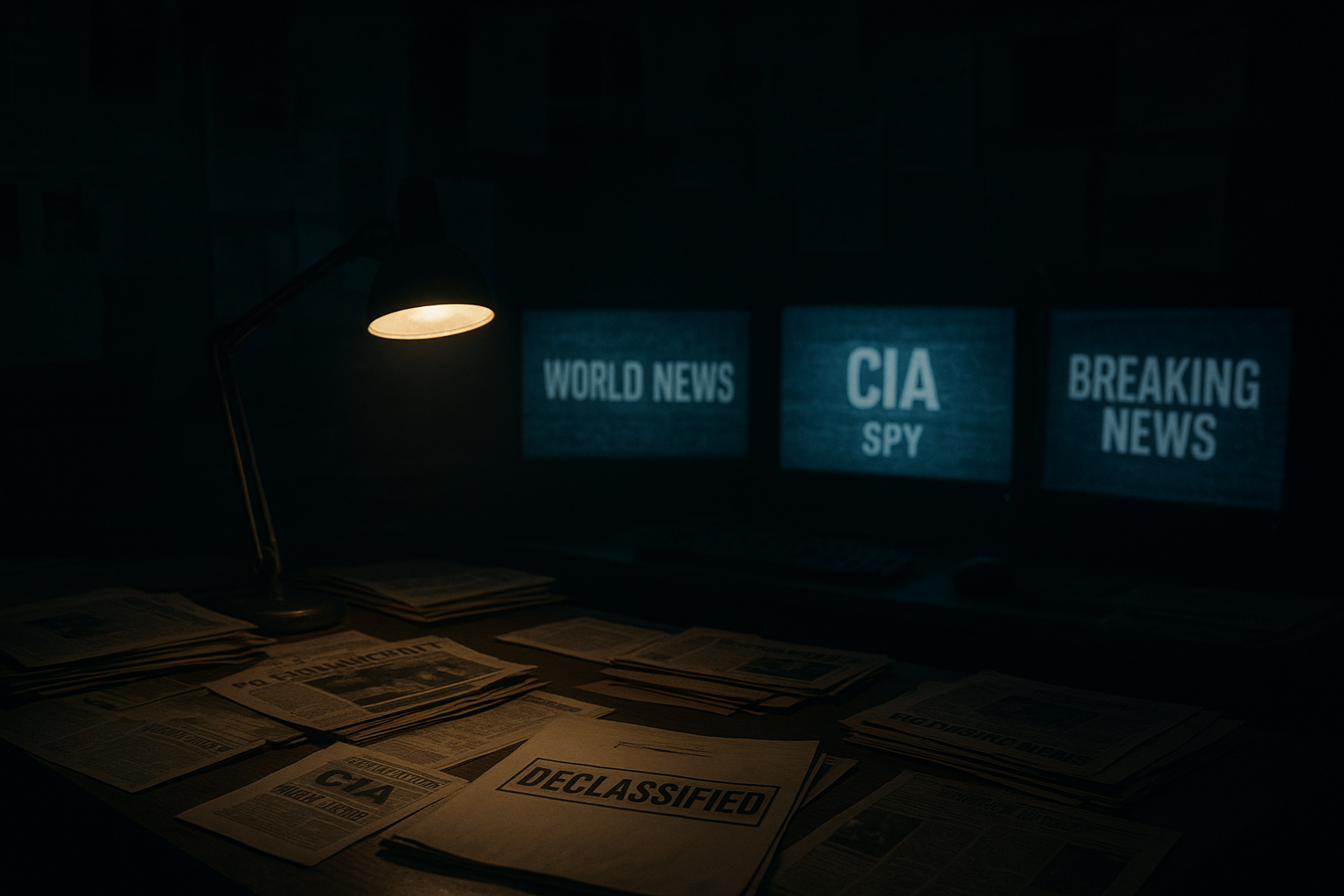
The CIA has always operated in two worlds: the visible one shaped by politics, and the invisible one shaped by information. Since 1947, the agency has used propaganda—soft power—as a strategic tool to protect U.S. interests, influence public opinion, and shape global events. The methods changed over the decades, but the mission stayed the same: control the narrative before the narrative controls the world.

This is a documented history of how propaganda became one of the CIA’s most effective weapons. No speculation. No conspiracy. Only what is historically verified and publicly acknowledged.
How It Began: Fear, Strategy, and the Birth of U.S. Propaganda
After World War II, the United States faced a new fear: global communism. American leaders believed the country needed a centralized intelligence organization capable of fighting a war of ideas. The CIA was created in 1947 under the National Security Act, and almost immediately, information became one of its primary battlegrounds.

Where the military fought physical wars, the CIA fought unseen ones—shaping perceptions, guiding international opinion, and keeping America’s image aligned with its political goals.
Operation Mockingbird: Propaganda Comes Home
One of the most documented examples of CIA information influence is Operation Mockingbird. Declassified files and a 1970s Senate investigation revealed that during the Cold War, the CIA quietly built relationships with journalists and major news organizations.

The goal:
Promote pro-U.S. narratives at home and abroad.
Through selective leaks, guided reporting, and strategic partnerships, the agency influenced how global events were framed. While not every journalist was controlled, enough were connected to create an ecosystem where the CIA’s preferred narrative often became the dominant one.
This shaped how Americans viewed the Soviet Union, foreign conflicts, and even domestic political debates.
Global Operations: Elections, Coups, and Ideological Warfare
Propaganda wasn’t limited to the United States. It became a central pillar of CIA influence overseas, especially during the Cold War. Documented operations in Iran (1953), Guatemala (1954), and Chile (1973) show how messaging campaigns helped:
- Sway public opinion
- Undermine leaders seen as threats
- Bolster U.S.-friendly governments
- Create conditions for coups or regime change
Posters, radio broadcasts, planted stories, and psychological tactics were standard tools. The United States feared that if these governments shifted toward the Soviet Union, the global balance of power would collapse. Propaganda became a frontline defense.
MK-Ultra: The Darkest Chapter in CIA History
From the 1950s to the 1970s, the CIA ran MK-Ultra, a program designed to study psychological manipulation. Declassified documents and congressional reports show the agency explored:
- Mind-altering drugs
- Hypnosis
- Sensory deprivation
- Behavioral conditioning

Some experiments were conducted without subjects’ consent, leading to public outrage when details emerged. MK-Ultra proved that once an intelligence agency becomes comfortable manipulating perception, the line between security and ethics can blur.
The Media Revolution: Television and the Birth of Narrative Politics
By the late 20th century, the CIA didn’t need to directly control the media. The rise of television and cable news made narrative shaping easier. Strategic leaks, anonymous sources, and carefully timed information flows became normal parts of political communication.

Events like the Vietnam War, Watergate-era revelations, and the Iran-Contra affair showed the complex relationship between intelligence agencies, politicians, and public perception. The world was learning that information itself had become a battlefield.
The Internet Era: Disinformation Becomes a Global Marketplace
The arrival of the internet changed everything.
Information decentralization meant the CIA could no longer dominate narratives the way it did during the Cold War. Instead, influence became faster, messier, and harder to control.

Governments worldwide developed their own digital propaganda strategies. Social media opened the door to:
- Algorithmic manipulation
- Viral falsehoods
- Covert influence campaigns
- Psychological targeting
- Echo chambers
The modern CIA now operates in an environment where influence moves at the speed of a viral post. To stay relevant, intelligence agencies focus on speed, data, digital networks, and countering foreign disinformation just as aggressively as they once spread their own.
When False Narratives Shape Real Decisions
Propaganda doesn’t always look like a lie. Sometimes it is omission, exaggeration, or framing. Throughout history, intelligence-driven narratives accurate or not—have influenced:
- Support for military action
- Fear of foreign threats
- Public opinion during crises
- Election rhetoric
- Media-driven panic
These moments shaped national identity and global politics. They also taught the public to question official narratives, sparking a new era of skepticism.
The Trust Crisis: Why People Doubt Institutions
Today, the public is more aware than ever of past propaganda campaigns. This awareness eroded trust in government agencies, news outlets, and even scientific institutions. When citizens discover decades of narrative manipulation, doubt becomes the default.

The modern challenge isn’t propaganda itself—it’s the confusion it leaves behind.
“Propaganda doesn’t just change what people believe. It changes what they question. It changes what they fear. And eventually, it changes how a society sees itself.”
The CIA shaped eras, influenced identities, and set the tone for global narratives without ever being front-and-center. But awareness is a powerful antidote. When you understand the tools, you stop being controlled by them.
You must be logged in to post a comment.