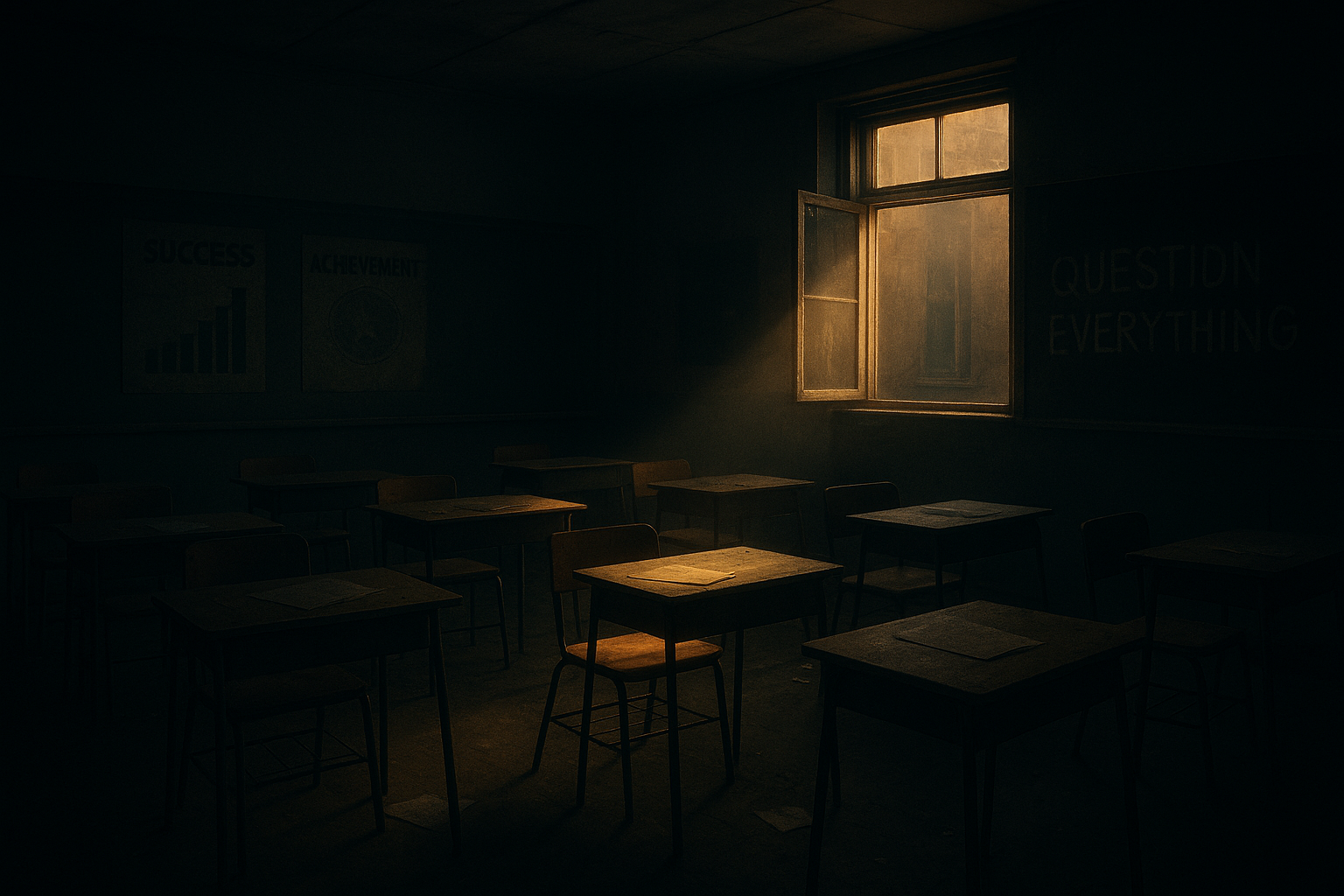
Introduction: The School Before the System
We like to believe high school is just a phase — a temporary space where teenagers prepare for adulthood, get an education, and find themselves. But what if it’s more than that? What if high school is the blueprint for the real world — a controlled environment that trains us not to think freely, but to function predictably within a larger system?

From student government to sports, from standardized testing to the social hierarchies in the hallways, high school quietly mirrors the structure of society. It’s not just preparation — it’s programming.
The Debate Team and the Illusion of Choice
Debate teaches critical thinking, persuasion, and the ability to see multiple sides of an argument — but only within the boundaries set by the system. Students are praised for defending ideas they don’t believe in, for mastering logic over truth, and for winning over understanding.
This mirrors our modern political landscape: leadership reduced to performance, policy to persuasion. Both debate and government thrive on structure, timing, and rhetoric — yet neither truly rewards honesty or innovation.

“We are taught to argue, not to question; to win, not to awaken.”
In both arenas, power is simulated. It’s not about governing — it’s about convincing. And those who master the format become the system’s best defenders, not its reformers.
Student Government: A Mock Democracy
Student government feels empowering — speeches, elections, leadership roles but most students soon discover their power is symbolic. Decisions still pass through higher authority: teachers, administrators, and policy boards.

It’s a safe rehearsal for real-world politics, where influence exists in appearance, not autonomy. Students learn how to campaign, compromise, and manage bureaucracy but not how to dismantle it.
We are trained to move within the system, not to change it.
Sports and the Politics of Competition
Team sports teach discipline and resilience, but they also shape our view of success and failure. Only a few make varsity; the rest learn to compete endlessly for limited recognition.

This mirrors capitalism itself — a game of winners and workers, where value is tied to performance. Cooperation is overshadowed by rivalry. The scoreboard becomes the standard of worth.
It’s not just physical training — it’s social conditioning.
The Curriculum of Control
The classroom is the core of the design. For decades, education has been built on repetition, memorization, and obedience. History is taught through selective lenses and the victors’ perspective while inconvenient truths fade into footnotes.

We’re taught to recite information, not to challenge it. We’re told to follow the process, not to question its purpose.
Even the subjects reflect societal priorities: math for economy, history for nationalism, language for compliance. Creativity, intuition, and consciousness often sit at the margins, labeled as distractions rather than direction.
Life After the Bell: The Adult High School
Graduation doesn’t end the system — it expands it. The office becomes the classroom; the boss replaces the teacher. Paychecks become grades. We trade report cards for performance reviews, yet the expectations stay the same: obey, produce, repeat.

The same cliques exist. The same politics. The same pressure to fit in, play along, and follow rules that rarely make sense. Society rewards adaptability over authenticity — a continuation of the lessons learned behind school walls.
The Lost Art of Free Thinking
High school was never just about academics; it was about socialization — a process of turning raw potential into manageable conformity. The thinkers, creators, and challengers of the system are often labeled “difficult” or “disruptive.”
But those are the same minds that have always sparked change. The system fears free thinkers because they expose its structure — its reliance on repetition and fear.

Until we unlearn what school taught us about success, failure, and authority, we remain students in a system that thrives on our obedience.
“Graduation is not liberation. It’s promotion into a more complex form of control.”
Reflection Sidebar
- How much of my thinking was taught, not discovered?
- Do I compete or collaborate?
- Am I free, or just functional?
True education begins when we stop memorizing and start questioning.
Closing
The point isn’t to condemn education — it’s to decode it. High school, like society, can be a powerful tool if we learn to see its purpose beyond compliance. The real lesson lies in reclaiming our curiosity and refusing to let systems define the limits of our potential.
by Bekah Fox — The Pattern Analysis
Rethink what you’ve been taught. Relearn what it means to be free.
You must be logged in to post a comment.