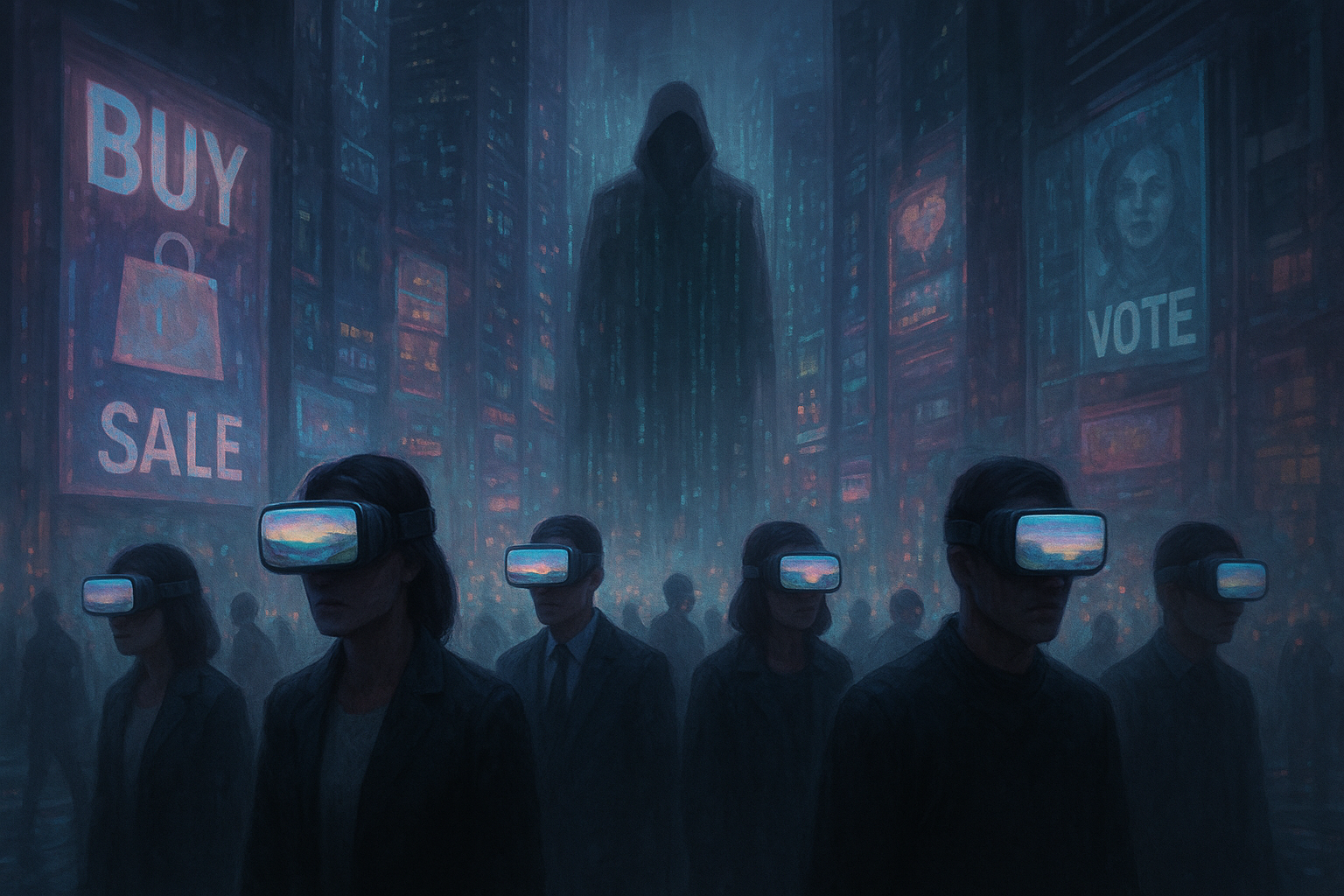
The New Face of Propaganda
Propaganda isn’t what it used to be. It’s no longer posters on the street or politicians on television shouting slogans. Today, propaganda hides behind algorithms, recommendation systems, and marketing campaigns designed to make you feel instead of think.

In the digital world, indoctrination is subtle. It’s built into the code that decides what you see, when you see it, and how it makes you respond. Every click, like, and scroll teaches the system how to influence you better next time.
Modern propaganda doesn’t scream—it whispers.
The Algorithm is the New Author
Your social media feed is a psychological experiment running 24/7. Every time you engage with a post, the system learns what holds your attention and what drives your emotions. The result is a personalized universe where you’re fed content that confirms your beliefs, fuels your fears, or keeps you hooked.

This is the invisible machinery of persuasion.
Platforms no longer simply deliver content—they shape it to align with what keeps you engaged.
Truth isn’t the priority. Engagement is. And engagement, in this system, equals control.
Advertising and Indoctrination
Advertising has always been about persuasion, but now it’s psychological warfare.
Data companies have built detailed profiles on every user—your habits, interests, insecurities, even your moods.

That data fuels “micro-targeting.” You might see an ad your neighbor never will. Political campaigns use it. Corporations use it. Activists use it. Each message is fine-tuned to hit your specific triggers.
It’s propaganda that feels personal. And because it feels personal, it works.
The Psychology Behind It
Propaganda has always relied on emotional manipulation, but the digital age turned that art into a science.
- Fear and outrage spread fastest. Algorithms boost the most reactive content because emotional engagement keeps you scrolling.
- Repetition creates belief. The more you see a message, the more “true” it feels—whether it is or not.
- Confirmation bias locks you in. You’re surrounded by information that agrees with you, making alternative perspectives feel like attacks.
- Information overload exhausts you. The flood of content makes people too tired to question what they consume. That’s by design.
The system doesn’t need you to believe the truth. It just needs you to keep watching.
The Real World Impact
This isn’t abstract. It’s reshaping society.
Political movements rise and fall on social media. Misinformation spreads faster than facts. People live in echo chambers, divided not by geography but by algorithm.
When digital propaganda dictates perception, democracy becomes performance.
Citizens think they’re choosing freely—but they’re really choosing from pre-filtered options designed by unseen systems of power.
It’s psychological control masked as convenience.
Breaking the Spell
There’s only one real defense: awareness. Once you know the system’s design, you can stop reacting automatically.

Start by asking simple questions before you share or believe anything:
- Who created this message?
- What emotion does it want from me?
- Who benefits if I believe it?
Diversify your sources. Step outside your algorithm. Follow voices that don’t agree with you. Think critically about what you consume and what you create.
As a media host and investigator, your role is not just to expose lies, but to show the architecture of deception. The systems, the incentives, and the psychological tools behind modern propaganda.
Final Reflection
We live in an age where influence is invisible. Propaganda has evolved from posters and slogans into pixels and code. It doesn’t demand loyalty—it earns it through repetition, emotion, and illusion.
But the moment you see it for what it is, it loses its power.
That’s the real-world agenda: to understand the system, and to rise above it.
You must be logged in to post a comment.