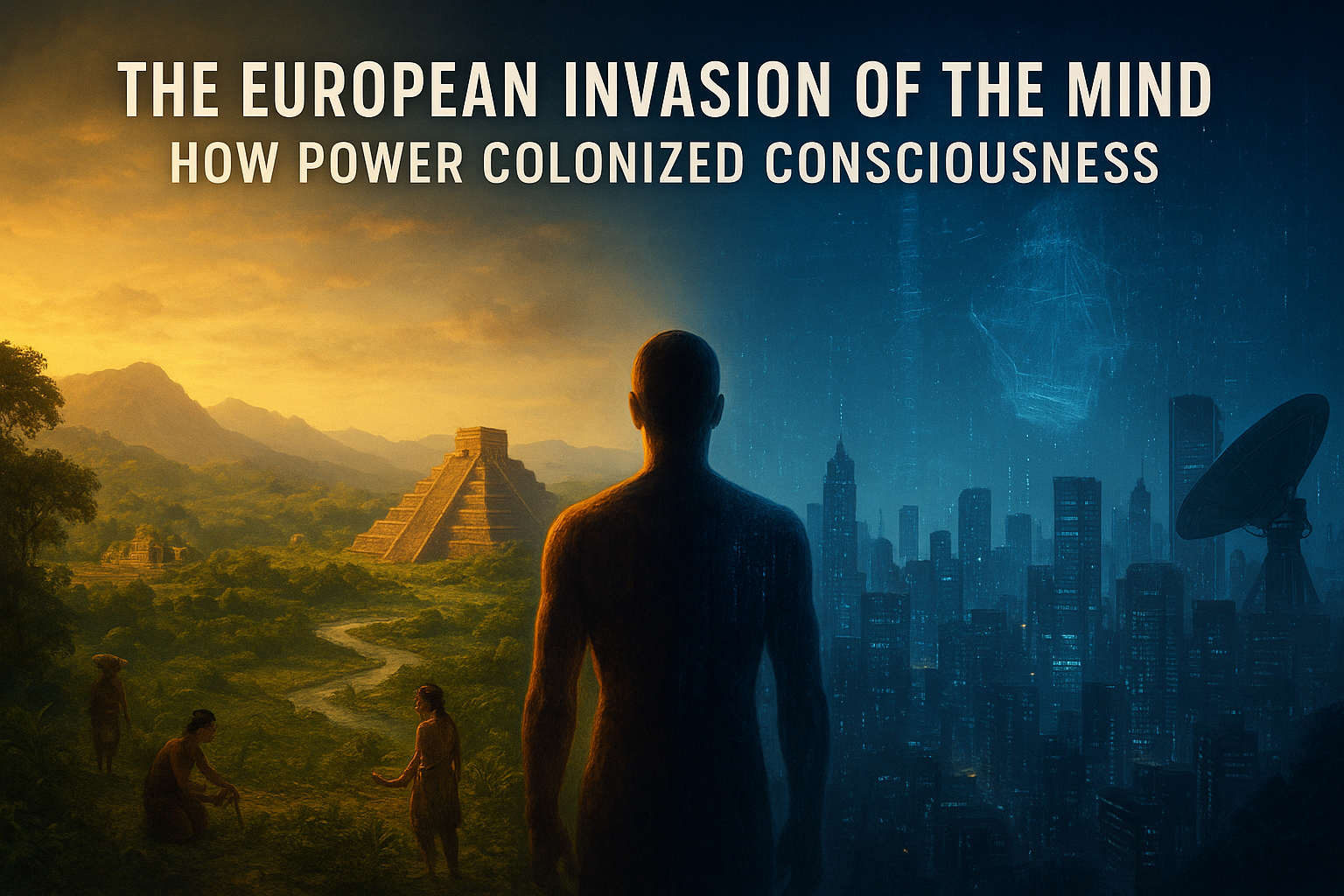
“Before they arrived, the land was already alive with cities, languages, trade routes, and wisdom older than empire.”
“The greatest conquest was never land — it was thought.”
Life Before the Pandemic of the Europeans
Before 1491, the Americas were not wild or empty they were alive. Millions of Indigenous people across the continents cultivated civilizations that rivaled and, in some ways, surpassed Europe. From the engineering marvels of the Inca roads to the democratic councils of the Haudenosaunee, this hemisphere was an ecosystem of brilliance, balance, and belonging.

This was not a “New World.” It was a world already whole.
The forests were managed, rivers were mapped, and food systems thrived in symbiosis with nature. The land itself was a sacred text — read, understood, and cared for.
Then came the invasion.
The European Arrival: The Great Disruption
What followed 1491 was not discovery — it was disruption. The arrival of Europeans unleashed a pandemic not only of disease but of ideology. They came armed with the cross, the crown, and the concept of ownership.

The so-called Age of Discovery was the beginning of a systematic erasure. Indigenous worlds were rewritten as blank slates. Lands were seized, histories buried, and languages silenced.
The physical collapse of the Great Dying — killed millions. But the deeper wound was psychological: the destruction of cultural memory.
What began as conquest of continents evolved into colonization of the mind.
From Colonization to Civilization to Control
Once European powers secured dominion over land, they turned to the next frontier — human consciousness. The tools of conquest changed from swords to sermons, from muskets to manuscripts.

Education became indoctrination. Religion became rule. History became propaganda.
The colonized were taught to doubt their own divinity and adopt European values as universal truth.
“The empire learned that the surest way to rule a people is to control what they believe about themselves.”
Over generations, this conditioning reshaped identity. To be civilized meant to be European. To be spiritual meant to be Christian. To be human meant to conform.
The Mind as the New Colony
By the 20th century, empires no longer needed fleets — they had media. The newspaper, the film, and later, the television became the new missionaries of European thought.
Today, the same power structure lives on through algorithms. The digital world mirrors the colonial one: data is the new land, attention the new gold.

Platforms built in the West dictate global perception. Narratives are filtered through European lenses. Black and Indigenous voices are censored, commodified, or co-opted for profit.
Freedom became performance — the illusion of choice under digital surveillance.
“The empire didn’t fall. It just upgraded its software.”
Reclaiming the Pre-1491 Mindset
To decolonize thought, we must return to what existed before 1491 — a consciousness rooted in connection, not control.

The Indigenous world thrived on balance, communal harmony, and respect for the unseen. Their systems of governance, ecology, and spirituality embodied sustainability long before it became a trend.
That consciousness was not lost — only suppressed. It lives in oral traditions, languages, and ancestral memory waiting to be reclaimed.
The Conscious Resistance
Breaking this generational hypnosis requires active reprogramming. Question everything taught as “truth.” Trace every ideology to its source. Ask who benefits from your beliefs.

To rebuild the mind, you must first recognize how it was colonized.
Mental sovereignty is liberation. The battle is not over land anymore — it’s over perception. Once we understand that the European invasion of the mind continues through media, religion, and algorithms, we can begin the real revolution: reclaiming consciousness.
Reflection Sidebar
- What parts of my identity were inherited from colonial systems?
- How has digital media replaced religion as the new missionary of control?
- What does it mean to return to pre-1491 wisdom in a post-algorithmic world?
Conclusion: The Revolution Within
The invasion began with land. It ends with thought.
1491 marked the last moment of hemispheric harmony before conquest — but it also marks the blueprint for future restoration.
The task now is to reverse the pandemic of control, to remember the world before empire, and to rebuild the world after illusion.
“To free the world, you must first free the mind.”
You must be logged in to post a comment.