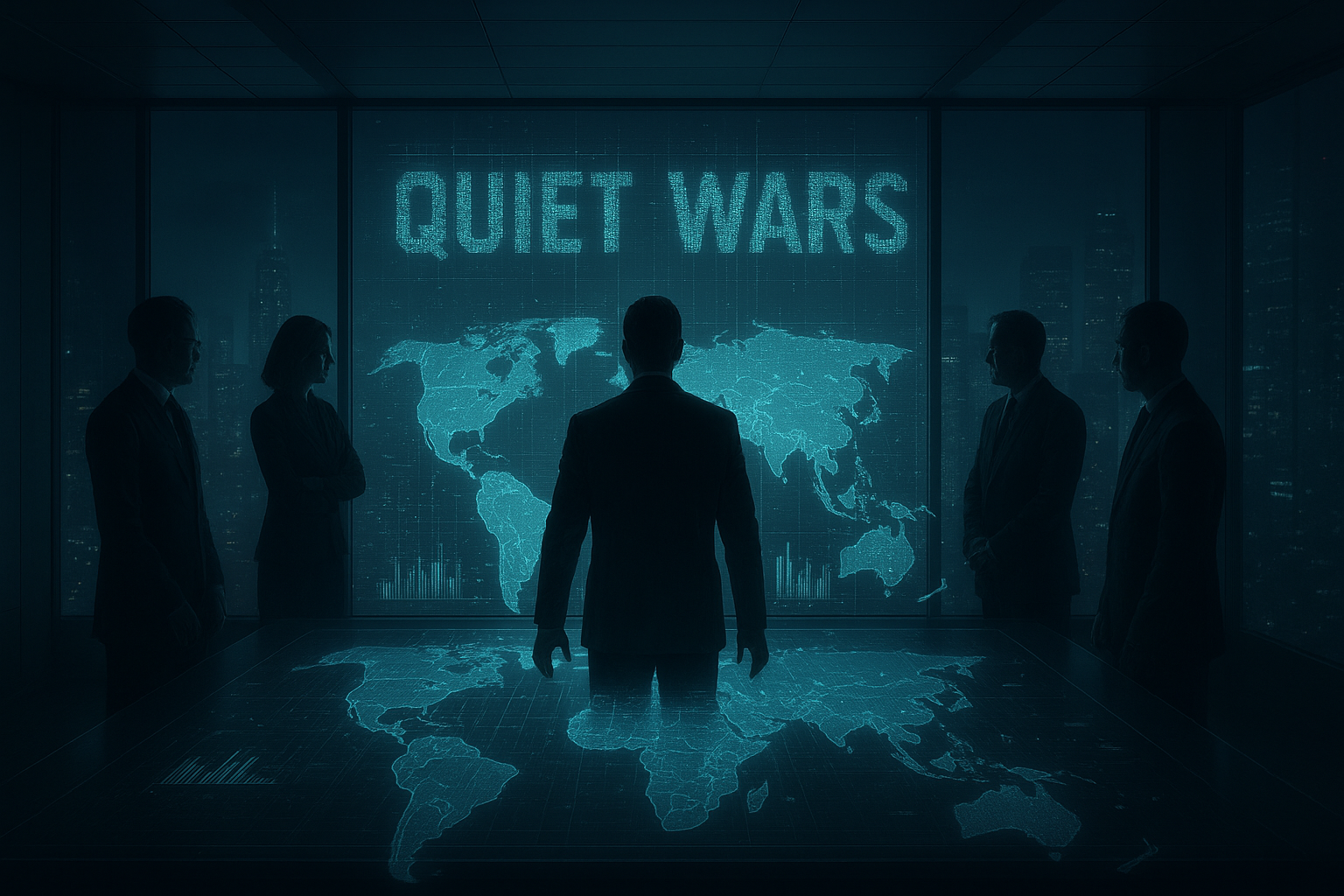
“All science is merely a means to an end. The means is knowledge. The end is control.”
— Silent Weapons for Quiet Wars, 1979
The War No One Heard Begin
Some wars are fought with missiles and men. Others unfold in silence—through data, finance, and psychology.
The document titled Silent Weapons for Quiet Wars, allegedly discovered in 1986 inside a surplus copier purchased at a government sale, reads like a technical manual for social control. It describes an economic system engineered to weaponize information and manipulate behavior without the public ever realizing it’s under attack.

Whether authentic or constructed as allegory, the text exposes a framework of control that mirrors the digital world we live in today—one ruled not by guns but by algorithms, economics, and engineered consent.
The Alleged Origin: A Hidden Declaration of War
According to the document, the “Quiet War” began in 1954, following a secret meeting of global elites.
The supposed foundation for this new war wasn’t military hardware, but social operations research—a science born from the Harvard Economic Research Project. It proposed that human societies could be modeled like machines, their energy measured, predicted, and redirected.
“To achieve a predictable economy, the lower-class elements of society must be brought under total control.”

This claim suggests that post-World War II economic studies weren’t just about rebuilding nations but about creating a new kind of control grid. By translating human behavior into mathematical equations, researchers could, in theory, simulate and manipulate societies the same way engineers manipulate electrical currents.
Energy, Economics, and Human Behavior
At the core of the document is a radical analogy: social energy = economic energy = electrical energy.
People, money, and influence are represented as parts of a circuit.
- Capacitance → Capital (stored energy: money, investments, infrastructure)
- Conductance → Goods and production flow
- Inductance → Services, labor, and public trust
The model implies that by controlling the flow of money and information, one can indirectly control human decisions. Currency becomes not a tool of freedom, but a weapon of guidance—a “silent weapon” that shapes reality through economic signals.
The Rothschild Principle: The Currency of Control
The document references Mayer Amschel Rothschild and his famous quote:
“Give me control over a nation’s currency, and I care not who makes its laws.”
Here, money is portrayed as the purest form of manipulation. Whoever controls its issuance controls public perception of value. By creating artificial scarcity, elites could trigger economic cycles, debt crises, and wars—each designed to reset the system while consolidating ownership.

This idea, though speculative, aligns with historical patterns:
- The creation of the Federal Reserve (1913) centralized monetary power.
- The Bretton Woods system (1944) tied global economies to U.S. control.
- The digital economy of today, powered by data and algorithms, now extends this model into every transaction and thought.
The New Weapon: Data
The “silent weapon” described in the 1950s manual foreshadowed what we now call surveillance capitalism.
“It shoots situations instead of bullets, propelled by data processing instead of chemical reaction.”
Every click, purchase, and search becomes an input in a feedback loop. The system studies these inputs, predicts reactions, and uses targeted information to guide collective behavior—much like a pilot adjusts a missile’s course.

When viewed through the lens of modern systems—social media algorithms, behavioral advertising, central bank digital currencies the Quiet War concept seems prophetic rather than fictional.
Shock Testing Society
One of the most chilling ideas in the text is “economic shock testing.” It compares human societies to aircraft: you apply stress, record their reactions, and map their weak points.
Wars, recessions, inflation, or pandemics all serve as shocks in this framework. Each one reveals how people respond under pressure—how fast they spend, what they fear, and when they break. With enough data, such patterns can be weaponized to steer entire populations.

In the 21st century, these “shocks” take the form of media crises, digital fear campaigns, and global economic resets each one testing compliance and endurance.
Education, Media, and the Manufactured Mind
The manual outlines a long-term plan: fragment families, downgrade education, and flood the public with entertainment and false narratives. Ignorance becomes infrastructure.
“The quality of education given to the lower class must be of the poorest sort… so that even bright individuals have little hope of extricating themselves.”
This systemic dumbing-down is mirrored today in algorithmic echo chambers and short-form content that rewards distraction over depth. A quiet war against attention itself.
Fact, Fiction, and Psychological Operations
Scholars and journalists widely consider Silent Weapons for Quiet Wars a “hoax” document, first publicly circulated in 1986 and popularized by William Cooper’s 1991 book, Behold a Pale Horse. No verifiable link exists between the text and any official agency.

However, its influence is undeniable. It crystallized postwar anxieties about surveillance, economic manipulation, and elite control—concerns that would later become validated by real programs:
MKUltra (1953–1973) — CIA behavioral modification experiments.
Operation Mockingbird (1948–1976) — media infiltration for propaganda.
NSA PRISM (2007–2013) — mass data collection revealed by Edward Snowden.
Fictional or not, Silent Weapons captured the blueprint of control systems that became reality.
Reflection: Are We Living the Quiet War?
Perhaps the greatest danger isn’t that Silent Weapons for Quiet Wars was real—it’s that its logic has been realized. A world governed by data, not democracy. A population pacified by media, not militaries.

If the first war of the 20th century was for land and oil, the wars of the 21st are for minds and metadata.
“Those who cannot understand mathematics cannot understand control.”
In the end, the “silent weapon” isn’t a machine—it’s the system itself.
References and Further Reading
- Leontief, Wassily. Studies in the Structure of the American Economy. Oxford University Press, 1953.
- Cooper, William. Behold a Pale Horse. Light Technology Publishing, 1991.
- Gatto, John Taylor. The Underground History of American Education. Oxford Village Press, 2000.
- Galbraith, John Kenneth. The Affluent Society. Houghton Mifflin, 1958.
- Norbert Wiener. Cybernetics: Or Control and Communication in the Animal and the Machine. MIT Press, 1948.
- Zuboff, Shoshana. The Age of Surveillance Capitalism. PublicAffairs, 2019.
- Snowden, Edward. Permanent Record. Metropolitan Books, 2019.
Reflection Sidebar
- Question: Who benefits when truth becomes indistinguishable from simulation?
- Action: Educate yourself in data literacy, economic systems, and psychological warfare.
- Goal: Break the illusion before it becomes your reality.
You must be logged in to post a comment.