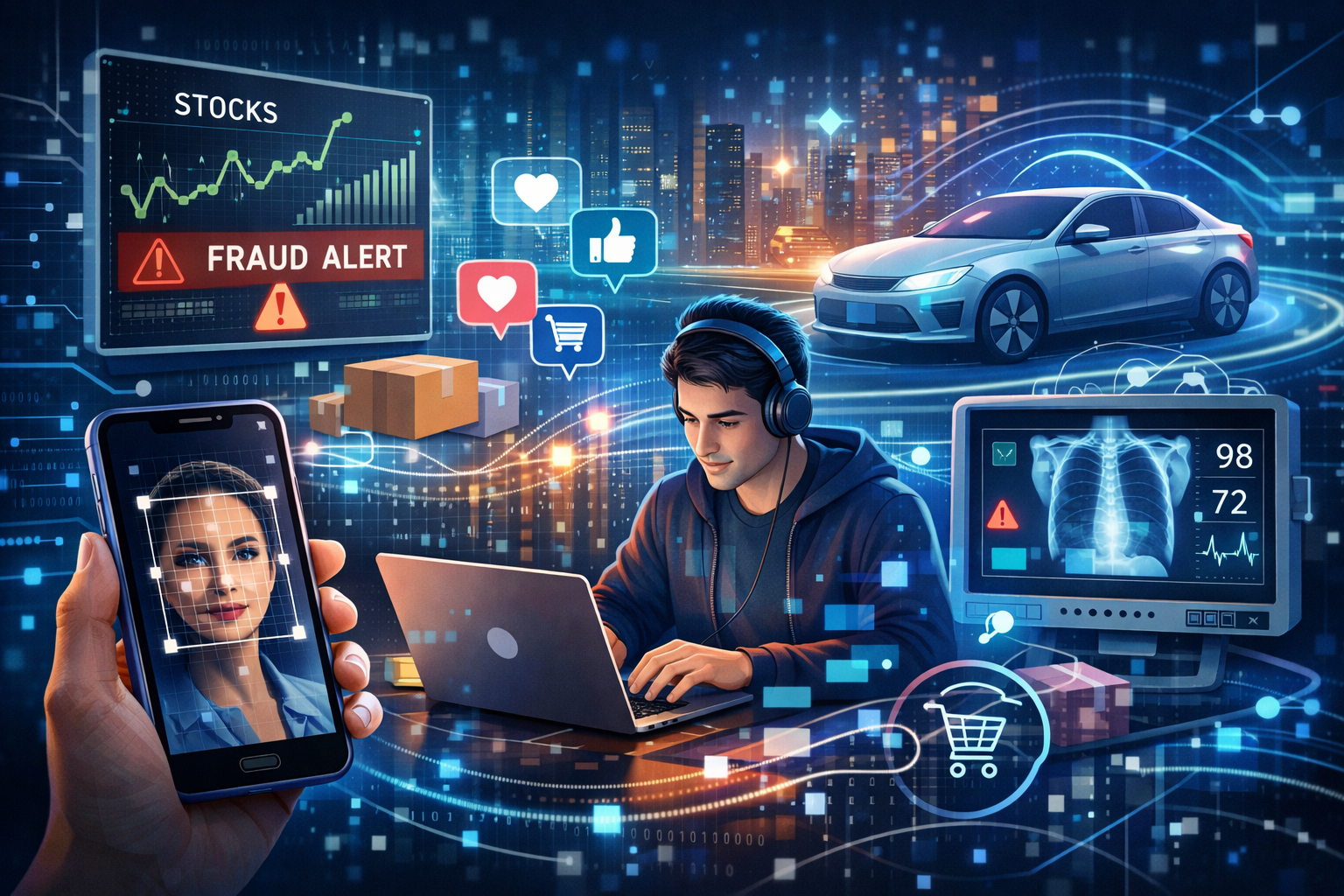
Artificial intelligence did not arrive as a revolution. It arrived as an upgrade.
No announcement. No vote. No public reckoning. It slipped into systems people already depended on and made them faster, cheaper, and more efficient. By the time anyone noticed, AI was no longer a tool. It was infrastructure.

Today, AI is condemned loudly and used constantly—often by the same people.
This is not a defense of AI. It is an exposure of how deeply embedded it already is, and how performative much of the outrage has become.
AI Is Not a Single Tool — It’s a Hidden Layer
Most public debate treats AI like a product: a chatbot, an image generator, a novelty that can be turned off if society decides it’s “too much.” That framing is false and dangerously incomplete.
AI operates as a layer beneath modern life.
Text You Didn’t Fully Write
AI drafts articles, outlines blog posts, rewrites headlines, optimizes content for SEO, and generates marketing copy designed to trigger engagement. Platforms use it to summarize posts, score content, and automate customer service conversations at scale.

Tools like ChatGPT, Claude, Gemini, Jasper, Copy.ai, Writesonic, and Rytr are not fringe experiments. They are standard operating tools for media, marketing, and business communication.
If you’ve read anything online recently, odds are AI touched it somewhere along the way.
Media You Didn’t Fully Create
AI generates and enhances images, videos, and audio. Canva, Adobe Express, Midjourney, Pictory, Lumen5, Descript, and Synthesia automate visual design, video editing, captions, voiceovers, and even virtual presenters.

Filters don’t just “add a look.” They analyze faces, lighting, and composition in real time. Deepfakes aren’t an accident—they’re the logical outcome of scalable realism.
This isn’t art replacing humans. It’s replication without friction.
The Most Powerful AI Is the One You Never See
The AI people argue about online is not the AI shaping their lives.
Your Devices Are Already Studying You
Autocorrect and predictive text learn your writing habits. Facial recognition unlocks phones and categorizes faces across platforms. Smartphone cameras use AI to manipulate lighting, focus, and color before you ever see the image.
The reality you capture is already edited.

Platforms Decide What Exists
Google search results are ranked by AI interpreting intent, behavior, and location. Instagram, YouTube, TikTok, Netflix, and Spotify track what you pause, skip, replay, and scroll past to shape what appears next.
Your feed is not neutral. It is engineered.

Amazon’s recommendation engine predicts purchases based on behavior patterns across millions of users. You don’t browse freely—you are guided.
Risk Is Managed by Machines
Email spam filters use AI trained on billions of messages. Banks and payment platforms like Venmo and PayPal monitor transaction patterns in real time to flag fraud and scams before you notice anything wrong.
Trust itself has been automated.

Healthcare: Where AI Becomes Untouchable
In healthcare, the debate ends quickly.
AI systems analyze X-rays, MRIs, and CT scans with precision that rivals—and sometimes exceeds—human radiologists. They flag cancers, fractures, and internal injuries earlier. In pathology, AI identifies cancerous cells more consistently. In genomics, it processes massive datasets to uncover disease-linked mutations.

Wearables and medical sensors feed AI continuous streams of data: heart rate, oxygen levels, blood glucose, sleep patterns. Algorithms detect subtle deviations that precede heart attacks, sepsis, or respiratory collapse—often before symptoms appear.
Early detection saves lives. Few people calling for “less AI” are willing to accept less accuracy.
Corporations Use AI Because Ideology Doesn’t Pay the Bills
AI adoption is not philosophical. It’s financial.
Social Media: The Algorithm Is the Editor
Instagram and other platforms use AI for filters, content moderation, feed ranking, and engagement prediction. Computer vision powers collages and face-aware edits. AI-generated summaries improve search visibility.
What trends isn’t organic. It’s optimized.

Finance: Machines Watch the Money
Venmo, PayPal, and major banks use AI-driven fraud detection systems that analyze billions of data points in real time. Unusual behavior triggers alerts instantly.
Human review comes after the machine decides something is wrong.
Retail and Restaurants: Efficiency Over Virtue
Applebee’s and IHOP, through parent company Dine Brands, use AI personalization engines to recommend menu items based on past behavior, increasing average order value. Grocery chains like Sprouts use AI for demand forecasting, inventory management, and waste reduction.

AI predicts what will sell based on weather, time of day, local events, and historical data. Inventory systems track stock in real time, trigger reorders automatically, and adjust menus to match supply.
Less waste. Higher margins. Fewer mistakes.
Automotive: AI at Every Stage
Mercedes-Benz’s MBUX system uses AI to learn driver habits and provide personalized assistance. Volkswagen and Mercedes rely on AI for driver assistance systems like adaptive cruise control, lane keeping, and object detection—some models reaching Level 3 autonomy.

Behind the scenes, AI optimizes manufacturing, quality control, supply chains, and even vehicle aerodynamics.
This is not innovation theater. It’s competitive survival.
The Environmental Argument People Don’t Finish
Yes, AI consumes energy. Data centers draw enormous power. Compute is expensive.
But the conversation usually stops there—conveniently.
AI also reduces fuel consumption through optimized routing, lowers food waste through demand forecasting, prevents overproduction, reduces labor inefficiencies, and minimizes human error at scale.

People who condemn AI while streaming content, ordering online, navigating with GPS, banking digitally, using smart homes, and scrolling algorithmic feeds are not rejecting AI.
They are outsourcing guilt.
The issue is not usage. It’s transparency, regulation, and control.
Who Actually Uses AI the Most?
AI dominance is driven by foundational systems, not hype culture:
1. Information Technology
2. Customer Service
3. Cybersecurity and Fraud Prevention
4. Financial Services
5. Media and Communications
6. Healthcare and Life Sciences
7. Retail and E-commerce
8. Manufacturing
9. Transportation
Industries slowest to adopt AI—agriculture and construction—are already being targeted next
The Real Divide No One Wants to Admit
This is not a battle between “pro-AI” and “anti-AI.”
It’s a divide between people who understand systems and people who perform outrage without understanding scale.
AI is not conscious. It is not moral. It is not political.

It reflects incentives, power structures, and human decisions. If it causes harm, it’s because humans designed, deployed, and monetized it that way.
Pretending AI is optional at this stage is intellectual dishonesty.
The future will not be decided by whether AI exists. That decision has already passed.
It will be decided by who controls it, who regulates it, who profits from it and who keeps pretending they’re not using it while relying on it every single day.
The machine doesn’t care about virtue signaling. It only responds to inputs. And most people don’t even realize how much they’re feeding it.

You must be logged in to post a comment.