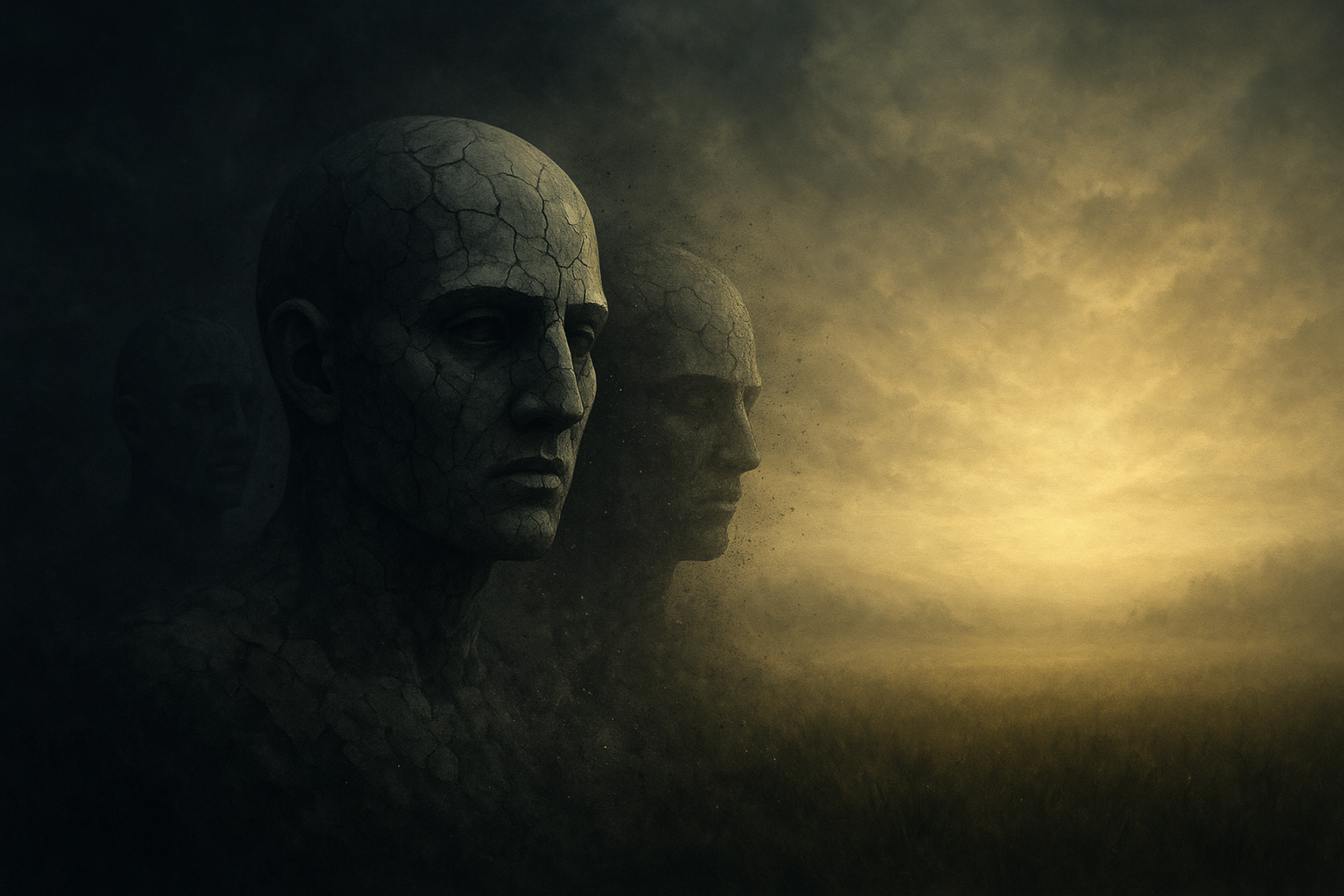
Racism is not only a social system of power—it’s a psychological disease masquerading as ideology. It infects the mind, spreads through generations, and manipulates logic until hate feels like heritage.

Modern psychiatry calls it learned behavior, but what happens when a learned behavior starts to resemble psychosis? When one’s entire worldview depends on believing in the superiority of one group and the inferiority of another?
The evidence is mounting: racism is both a social construct and a mental malfunction—an inherited obsession with hierarchy, control, and fear.
The Historical Illusion
Racism was not born from science, logic, or divine law—it was engineered. During the 15th and 16th centuries, as European powers expanded into Africa, Asia, and the Americas, they needed a moral excuse for greed. Race was invented as that excuse.
Through colonization and the transatlantic slave trade, “whiteness” was elevated into power while darker skin was criminalized, demonized, and commodified. Pseudoscientific “race theorists” like Johann Blumenbach and later eugenicists classified human beings by skull shape and skin tone an attempt to turn prejudice into data.

The result? A global psychological conditioning where superiority became a birthright, not a delusion.
Even after these false hierarchies were debunked, the mental framework survived. Slavery ended, but the ideology did not. It embedded itself into institutions, policies, and family traditions—creating generations of individuals who confuse inherited bias with identity.
Racism as Psychological Dysfunction
To understand racism as a possible mental disorder, one must see its symptoms.
1. Delusional belief in superiority.
Like a delusion, it defies evidence. Science has long confirmed that race has no biological basis—only social meaning—yet racists cling to the fiction of superiority as if denying it would erase their power.
2. Compulsive need for control.
Racism operates like addiction: the racist mind depends on hierarchy. It craves validation through dominance, often becoming enraged when equality threatens its illusion of order.
3. Paranoia and projection.
Many racist behaviors—border panics, hate crimes, “replacement theory” fears mirror paranoid delusions: the belief that another group’s very existence is a threat.
4. Social reinforcement of pathology.
Unlike most disorders, racism is socially rewarded in certain environments. Children inherit it from parents who call it “tradition,” churches mask it as “values,” and politicians repackage it as “policy.”
If a person believes, against all logic and evidence, that another human is less worthy of life, liberty, or opportunity due to skin color—what else can we call that but delusion?
Taught at the Table
Racism is not born it’s built. It starts in homes where children absorb casual prejudice before they learn to read.
While some parents teach survival, empathy, or financial literacy, others teach fear of losing privilege, fear of accountability, fear of equality.

Imagine if the same energy spent on hating entire groups was redirected into teaching children about wealth creation, mental health, or self-improvement. Hate produces nothing. Financial literacy builds futures. Yet generation after generation, many choose the former because hate is easier to teach than humility.
Racism, in that sense, is a cultural inheritance of dysfunction—a cycle of learned inferiority disguised as strength.
Why It Persists
Racism survives because it benefits power. It offers psychological comfort to those unwilling to face the truth about history or their own inadequacy. It allows the insecure to feel important without achievement.
It also thrives because societies have normalized it.

The legal systems that once codified slavery now disguise discrimination in zoning laws, sentencing disparities, and school funding. Media reinforces bias through imagery and omission. And social networks reward outrage, making hate profitable.
This normalization has made it difficult for psychiatry to classify racism as illness—because in many societies, it is the norm. The American Psychiatric Association has refused to list racism as a disorder, arguing it’s a “cultural problem.” But when culture itself is sick, should medicine remain silent?
Racism’s Impact on Mental Health
For its victims, racism is trauma.
It leads to anxiety, depression, and even physical illness caused by chronic stress—what psychologists call Race-Based Traumatic Stress (RBTS). The body cannot separate emotional violence from physical threat; both shorten lifespans, elevate blood pressure, and accelerate aging.

For its perpetrators, racism acts like a psychological poison. Studies link chronic prejudice to higher stress levels, cognitive rigidity, and poorer emotional regulation. In essence, hate corrodes the hater.
So while racism may not yet be in the DSM, its symptoms manifest in every clinic, every prison, every policy.
A Systemic Delusion
Racism’s greatest trick is convincing society it’s a political issue, not a psychological one. It turns pathology into patriotism, fear into pride. But racism is not natural. It is taught, rewarded, and sustained by institutions designed to preserve inequality.
That makes it both a social system and a collective mental disorder—one that has outlasted empires because it hides behind law, religion, and family values.
The Cure: Conscious Reprogramming
If racism is learned, it can be unlearned.
Education, exposure, and accountability are the vaccines. But that starts with honesty: admitting that racist ideologies are symptoms of deep psychological dysfunction—fear of loss, fear of difference, fear of reflection.

Healing a society infected with racism means dismantling systems that reward delusion and rebuilding ones that promote understanding.
It means teaching financial literacy instead of racial superiority.
It means diagnosing hate as what it truly is a sickness of the human spirit disguised as pride.
Conclusion
Racism should be classified as a form of sociocultural psychosis and a delusional system of control that damages both the oppressed and the oppressor. Until we treat it as such, we are not curing the disease we’re simply managing its symptoms.

The mind that hates what it does not understand is not healthy.
The society that protects such minds is not civilized.
And the future that ignores this truth will not be free.
You must be logged in to post a comment.