The Global Water Divide
Across the world, billions face what’s known as extreme water stress — when more than 80% of available water is consumed annually. The most water-scarce regions include:

- The Middle East and North Africa (MENA): 83% of the population lives under extreme water stress. Countries like Kuwait, Qatar, and the UAE have almost no renewable freshwater.
- South Asia: India and Pakistan face severe depletion from agricultural overuse and population growth.
- Central Africa: Nations like Chad and the Central African Republic face the highest lack of access, with over 90% of people living without safely managed drinking water.
These regions suffer not because the planet lacks water — Earth’s total water volume hasn’t changed but because of how humans manage it.
America’s Water Reality
The U.S. holds abundant freshwater, yet inequality and mismanagement create pockets of crisis.
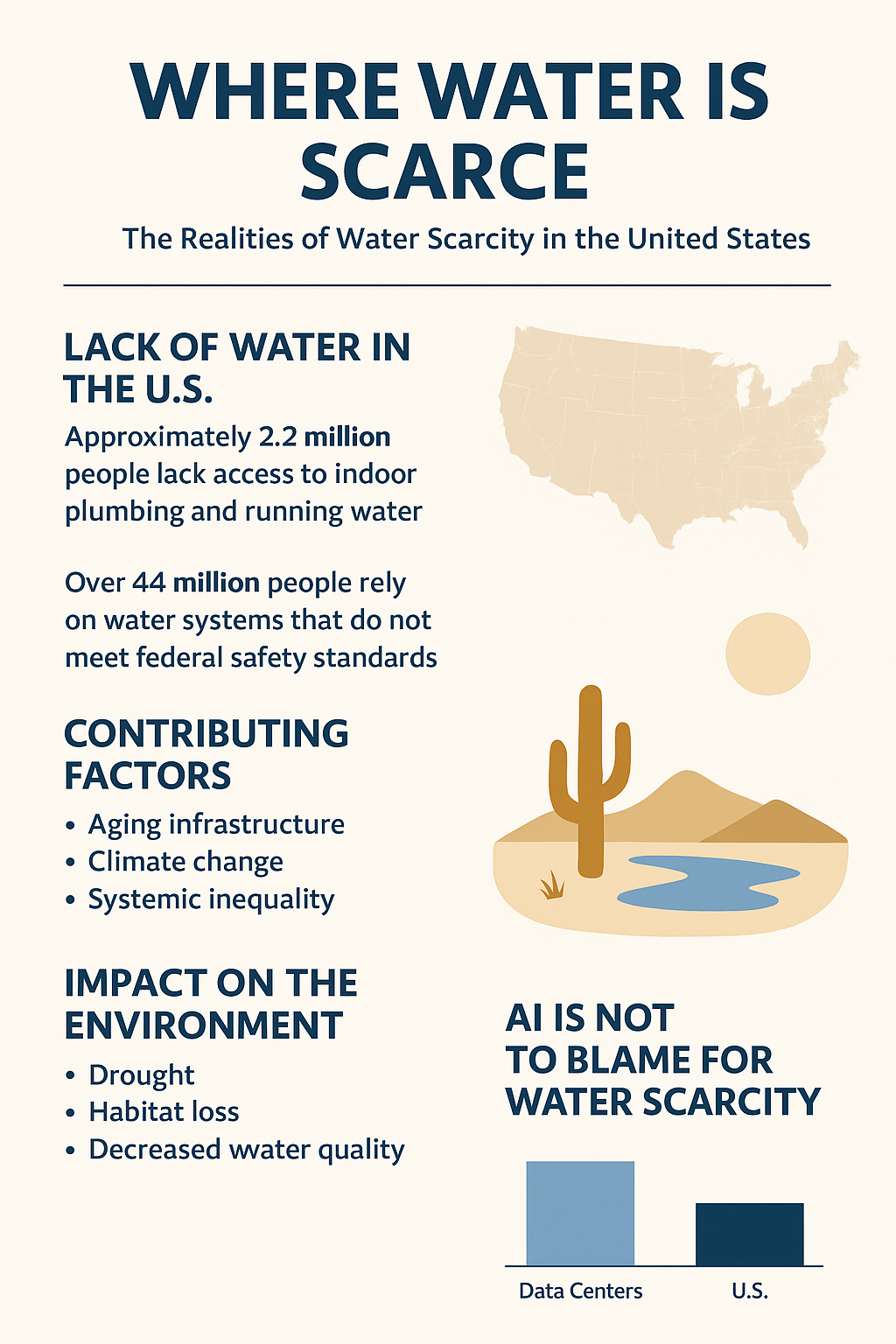
- 2.2 million Americans live without indoor plumbing.
- 44 million are served by unsafe or substandard water systems.
- Indigenous and rural areas are hardest hit — from the Navajo Nation, where families haul water for hours, to Lowndes County, Alabama, where failing septic systems expose residents to raw sewage.

But these cases, while severe, don’t represent a national collapse. The majority of Americans still have consistent water access. The issue is distribution, quality, and justice, not overall scarcity.
Environmental Impact and Climate Pressure
Climate change is intensifying the cycle — droughts, depleted aquifers, and contaminated groundwater. Reservoirs like Lake Mead and Lake Powell have reached record lows, revealing how water mismanagement collides with a changing planet.
Yet, again, this isn’t new. From the Dust Bowl of the 1930s to the California droughts of the 1990s, water crises have followed patterns of overuse and poor planning.
AI and the Water Debate
Recent debates have turned attention to AI, claiming data centers are “draining the planet.” The truth: AI’s water footprint exists, but it is a fraction of the larger crisis.
- Data centers use water to cool servers. One large facility can consume millions of gallons per day.
- Yet agriculture alone consumes 70% of global freshwater, dwarfing industrial and technological use combined.
- The real problem is not AI itself, but where these facilities are built and how water is managed around them.

AI didn’t cause droughts in the Middle East, groundwater depletion in California, or arsenic contamination on the Hopi Reservation. Human policies, consumption patterns, and neglect did.
The Human Fingerprint
For thousands of years, civilizations have collapsed under the same strain.
- The Akkadian Empire fell during a 300-year drought.
- The Mayan civilization declined after centuries of mismanaged water and soil exhaustion.
- Even ancient Angkor in Cambodia crumbled under the pressure of extreme droughts and floods.

Every era’s water crisis has one common denominator: human behavior. AI, like fire or steel, is a tool neutral until directed by human priorities.
The Path Forward
Fixing water scarcity requires investment, innovation, and accountability.
1. Rebuild infrastructure. Replace aging pipes, modernize treatment systems, and eliminate lead lines.
2. Conserve and recycle. Incentivize water recycling and improve irrigation efficiency.
3. Use technology wisely. Leverage AI for predictive drought modeling, leak detection, and smart agriculture.
4. Address inequality. Ensure rural and Indigenous communities are prioritized, not forgotten.
Final Reflection
The world’s water crisis isn’t an AI story it’s a human one. Technology can either deepen the problem or become part of the solution, depending on how it’s used.
Water is not running out. Wisdom is.
You must be logged in to post a comment.